The Book Is Here!

Some of you already know that I’m a poet as well as an activist.  My first book is now available.  This hot place cover image You should be able to find my collection of poetry, This hot place, at bookstores across Canada any day now.  I received my copies from  Thistledown Press a week and a half ago.

I begin a western Canadian tour in April with confirmed stops in Regina, Earl Grey, Prince Albert, Winnipeg, Saskatoon, Gabriola, Calgary and Vancouver.  It’d be great if my activist, writing and family friends were able to make the events we’ve lined up.  The more the merrier, y’know?  Tour dates are here, at my book blog.

If your town is not listed just let me know and we’ll see what we can work out.  I ‘m open to sharing my work in a variety of places, from curling rinks to bookstores, art galleries to bars, living rooms to conference rooms — you name it!  I’ll try my best to work it into my schedule.

I’ll head east for a few gigs in Ontario and the Maritimes and then south, down the Pacific coast, after the USA release of the book sometime in September.

Hope to see you somewhere along the path!

Budget 2010: Still Leaving Women Behind

This came my way via the PAR-L email list.  Huge thanks to Kathleen Lahey for this work.  It puts a light on the inherently sexist economic system in which women exist, a system Stephen Harper is determined to prop up, regardless how much it hurts women and their children.

Kathleen Lahey
Mar. 5, 2010

The big picture: Women are half the population in Canada and nearly half the official labour force – but still do 62% of all unpaid work, and receive only 40% of after-tax incomes.

This Budget: The government claims that it is providing one last $19 billion ‘stimulus’ package this year, shorn of new tax cuts or spending items. This is highly misleading. New corporate tax cuts and continued huge PIT and GST cuts bring the total to $41.9 billion for 2010/11.

Gender gaps This $41.9 billion is being delivered in forms that will benefit far more in Budget 2010: men than women, widen gender gaps even further, and continue to drive up poverty rates among women and single parents:

2010-2011: Amount: Women’s share:
Infrastructure spending $ 9.6 bill. 7% to 22%
Corporate tax cuts $10.1 bill. 10% to 37%
GST tax cuts $10.0 bill. 38%
Personal income tax cuts $ 7.4 bill. 40%
EI enhancements $ 4.8 bill. 36%
Single-parent UCCB tax cut $ 0.005 bill. 81% (max $168/C)

Infrastructure spending $9.6 billion, 2010-2011
($8 billion, 2009-2010)

• For 2010-2011, the ‘base’ infrastructure fund is $7.7 billion, which will continue to be allocated to road, municipal improvement, and building infrastructure:

– only 7% of construction, trade, transportation workers are women
– only 21-22% in engineering, manufacturing, and primary industries/women1

• For 2010-2011, an additional $1.9 billion is being added for post-secondary infrastructure, consisting of both construction and enhancement of selected areas of research and technology innovation:

– these construction funds will impact women in the same 7% to 22% range
– there are relatively few women in the research and technology areas targeted for the remainder of this funding: only 21% to 23% are women2

• No gender equity requirements have been included in any of these spending programs

• Tying provincial and municipal construction project criteria to federal funding forces provinces/local governments to match funds on the same terms (provincial shares: 61%) and continues to block child care projects desperately needed across the country

• Will women get another 2 shelters this year? (Cf 3 animal shelter projects in 2009)
Corporate income tax cuts $10.1 billion, 2010-2011
($6.3 billion, 2000-2010)
($44.8 billion, 2010-2014)

• These tax cuts were announced beginning in 2006, were accelerated in 2008, and will be fully implemented in 2012 – they reduce the general rate from 22.12% to 15% by 2014

• By 2014, total federal revenues produced by corporate income taxes will have been permanently cut by a third of former corporate tax revenue

• The $10.1 billion cut in 2010-2011 reflects the 1% cut that came into effect in 2009 plus the new 1.5% cut coming into effect in 2010 (but buried in fine print in Budget 2010)

• These cuts permanently depress Canada’s annual revenue, and form one basis for the argument that Canada cannot fund programs like child care or women’s services

• The federal government has been pressuring provinces to make similar large rate cuts

• Once the combined federal-provincial corporate income tax rate falls below 35%, the US government will begin collecting a share of Canada’s foregone CIT revenues

• The government itself has admitted that corporate income tax cuts only weakly promote economic growth (Budget 2010, table A1.1)

• Men will be the largest beneficiaries of these cuts, because almost all CEOs, directors, and controlling shareholders are men, and 63% of corporate shares are owned by men

• One of the tax benefits of receiving corporate dividends is that the first $50,000 is tax exempt ($34,000 if issued by small business corporations) – compare this with those who live on subsistence incomes of $10,320 or less – such low incomes are PIT-free, but will still bear total taxes of 17.175% from the GST/HST-PST, EI, and CPP GST tax rate reductions (2%) $10 billion (annual) ($34.8 billion 2007-2011)

• The GST and PST/HST are highly regressive, giving the biggest benefits to those with the highest incomes regardless of whether they save or spend

• The GST tax credits refunds only a small part of the GST that is paid by those with low incomes (the credit covers the tax on approx. $4,750 of spending)

• GST tax savings per year on spending, for taxpayers in —

Bottom income quintile: $280
Top income quintile: $1,244

• The 2% rate cut has contributed substantially to the sharp reduction in federal revenues, thus impairing federal capacity to go ahead with adequate affordable child care or expand EI to give benefits to more marginalized members of the labour force

• As the federal government has placed pressure on provinces to induce them to ‘harmonize’ their PSTs with the federal GST, provincial tax bases are being expanded to include previously non-taxed services, resulting in further increases that affect lowincome taxpayers the most negatively (usually without offsetting low-income credits)

• 62% of these federal GST tax cuts go to men, 38% go to women Personal income tax cuts $7.35 billion, 2010-2011
($18.4 billion, 2008-2010)

• Lowest income tax rate reduced from 16% to 15%: ($5.5 bill)

– At least 40.4% of women receive no benefit from any of these cuts because their incomes are so low they already pay no income taxes

– These cuts to to middle and high income taxpayers too – to all taxpayers
– Women’s average incomes are too low to use the whole benefit of this cut
– The average benefit to men of this cut is $196 – to women, $171
– Men receive 57% of this cut, women, 43%

• $220 increase in the personal exemption: ($0.55 bill.)

– At least 40% of women will receive nothing from this cut (no tax liability)
– This cut is also available to all taxpayers, no matter how high their income
– 54% of this cut goes to male taxpayers; maximum cut/year = $333

• $1,894 increase in the lowest income bracket (15%): ($1.0 bill.)

– Only 14% of all women taxpayers can get this tax cut (and 30% of all men)
– 67% will go to male taxpayers; maximum cut/year = $1324

• $3,788 increase in the second income bracket (22%): ($0.3 bill.)

– Only 6% of all women taxpayers will enjoy this tax cut (and 14% of all men)
– 70% of this cut goes to male taxpayers; maximum cut/year = $1515
Employment insurance $4.8 billion, 2010-2011
($2 billion in 2009-2010)

• For 2010-2011, $2.6 billion of this total is being allocated to further extensions of EI for those with ‘standard’ eligibility for regular benefits

• For 2010-2011, an additional $2.2 billion is being allocated to labour market adjustment projects in regions facing special challenges

• Regardless of program allocations, those working less than 35 hours per week during qualifying periods have marginal eligibility

• Because 70% of all part-time workers are women, and because the hourly wages of women in all employment categories are lower than men’s, only about 36% of those receiving regular EI benefits are women

• The EI extensions offered in 2009 and 2010 (announced in Budget 2009) are only available to workers already qualifying for EI; they do not bring other workers into EI

• The new women workers who might qualify under EI enhancements are those who stayed at home for long periods of time with their children – not women in nonqualifying paid work who have only taken time out for maternity leave, and who are disproportionately disadvantaged in obtaining those EI benefits due to the current eligibility criteria

• There is growing support for the 360 hour EI qualification test

• Postponement of increases in employee contribution rates and reduced employer contribution rates that have never occurred are not real tax benefits Home buyer tax credits $200 million in 2009-2010

• These credits will only be available to those who can afford to purchase a home

• Because these credits are not refundable, even low-income taxpayers who are able to purchase a home cannot use them, because they will have no tax liability against which to offset them

• On average, women will thus receive far fewer credits under this program, because their average incomes are much lower than men’s:
– women’s average incomes: $27,000
– men’s average incomes: $45,0006

• Most women’s incomes fall into the three lowest income quintiles, all of which are net dis-savers – they end every year with net debt7

• For the same reasons, low income taxpayers – predominantly women – will not have RRSP savings that they are allowed to roll into home purchases on a tax-free bases Working income tax benefit $580 million per year

• The current Working Income Tax Benefit (WITB) is $522/year for a single individual and $1044 for a single parent; Budget 2009 enhanced these benefits to the current levels:

– Single individuals: to $925 credit per year, phased out at income of $16,700
– Single parents: to $1,680 credit per year, phased out at income of $25,700

• Only one spouse/partner or the other can claim this credit

• Women who cannot enter paid work without affordable reliable child care will not be able to take advantage of this increased credit Canada child tax benefit $230 million/year

• The brackets measuring the phase-out of the Canada Child Tax Credit and the National Child Benefit Supplement are each being increased by the same $1,894 that is added to the 15% income bracket

• The result of this change is to increase at the top end of the brackets used to phase-out these two low-income benefits, adding a bit more to the after-tax income of the parents currently receiving the CCTB or NCB Supp at the highest end of that income scale

• No new money is going to parents at the low end of the income brackets used to measure qualification for these benefits, however UCCB/Single parent calculation $5 million/year

• The ‘Universal Child Care Benefit’ was introduced in 2006 to replace the $5 bill. national child care program established in 2005 (UCCB cost/year = $2.1 billion)

• The government claimed that it ‘will support child care choices by families’8

• The UCCB is taxable, and this change will reduce the single parents’ tax on it by $168/yr

• Even the full UCCB ($1200/yr) is far too little to enable single parents to ‘choose’ to stay at home to care for their children vs. pay for childcare so they can earn income Joint tax measures Ongoing; expanded in 2006

• All joint fiscal measures create disincentives to women’s paid work

• Joint low-income refundable tax credits impose tax penalties on low-income women:

• There are a few tax benefits that are designed to provide refundable credits to those whose incomes are too low to be able to claim ordinary tax benefits (40.4% of women) GST tax credit Canada Child Tax Benefit
Working Income Tax Benefit [$580 mill/yr; $522 single; $1044 couple]

• However, these refundable credits are all subject to couple-based LICOs that artificially bar many low-income women from receiving these refundable credits

Single taxpayer: $13,500 [2009: $16,700]
Coupled taxpayer: $21,500 [2009: $25,700]

• These couple LICOs raise the ‘welfare wall’ for low-income women in relationships

• They impose tax penalties on relationships without regard for the economic realities of those relationships

• Open-ended joint tax measures undermine women’s economic security:

• Unlike joint provisions for low-income refundable tax credits, many joint tax benefits discourage women with mid/high income spouses/partners from earning income

• Most joint tax benefits reward higher income spouses for supporting their spouse/partner

– without any upper limits on eligibility, no matter how high the income (e.g., dependent spouse credit and transferrable spousal credits; family limits on child care deductions; spousal RRSPs; caregiver credits; Universal Child Care Benefit; pension income splitting; TFSA investment income splitting)

• Pension income splitting (2006 onward; $0.6 bill/year): For couples only: The higher the income of the supporting spouse, the higher the tax benefit from pension splitting:

Supporting spouse/ $26,800 Tax benefit: —
partner income: $31,800 $500
$41,800 $700
$72,000 $2,975
$100,000 $8,125
$140,000 $11,216

• Creates fiscal disincentives for lower-income spouse to work after higher-income spouse/partner retires, to have own-source pension income, or a spousal RRSP Tax-free savings accounts: $0.5 billion (2009; expanding)

• $5,000 can be contributed to tax-exempt accumulation accounts each year for ultimate tax-exempt withdrawal; $10,000 per couple; $5,000 per adult child

• Only the top quintile of households have enough savings to fully fund TFSAs fully9

• Spousal TFSAs are not required to remain the property of the non-earning owner

1. Statistics Canada, ‘Work Chapter Updates,’ Women in Canada (Ottawa: 2005); online:
http://www.statcan.ca/english/freepub/89F0133XIE/89F0133XIE2006000.htm.
2. Statistics Canada, ‘University Enrolment, 2007/2009,’ The Daily (July 13, 2009);
online:
http://www.statcan.gc.ca/daily-quotidien/090713/tdq-9-713-eng.htm.
3. Based on data in CRA, Income Statistics 2007.
4. Based on data in CRA, Income Statistics 2007.
5. Based on data in CRA, Income Statistics 2007.
6. Canada Revenue Agency, Income Statistics 2007 [2005 tax year] (Ottawa: 2007) table
6,
at 15-16; online: http://www.cra-arc.gc.ca/gncy/stts/gb05/pst/fnl/pdf/table6-eng.pdf.
7. Sauve, Vanier Insitute for the Family, 2005.
8. Hon. Flaherty, Minister of Finance, The Budget Speech 2006 (May 2, 2006); online:
http://www.fin.gc.ca/budget06/speech/speech-eng.asp.
9. Sauve, Vanier Insitute for the Family, 2005


Racist Screed by Con MP Peter Goldring

This racist screed was sent to Edmonton East constituents by their Conservative MP, Peter Goldring, in his householder in December 2009.  Yes, folks, your tax dollars paid for racist literature!

There are those today who want to change the historical record regarding 19th century Metis leader Louis Riel. Peter Goldring, Member of Parliament for Edmonton East says that such historical revisionism is wrong and sets the record straight on Riel and his crimes.

Concerned?

Wait, there’s more!

Revisionist “time travel” ignores the reality of human suffering. History is there to be learned, not to be revised or reinter-preted today by persons who do not like the outcomes of over a century ago. “Time travelling” back to the Riel era and erasing this judgement from our history books as if it were wrong, would in itself be wrong. How can we possibly know what was in the minds of people 100 years ago, to re-judge them today, years af-ter the fact. How can we obtain a true ap-preciation for those issues, without the sweat of fear and the odour of death that those events caused across the West in that era?

His prejudice certainly shows through in that paragraph, eh?  How about considering the suffering of the Metis, Peter?  Or is that to Peter Goldring, the Metis Nation is not part of humanity?

He also says that a pardon for Riel would mean Canada was insulting the soldiers who fought against Riel on behalf of Canada.

So many people today appear to know little of and care less for the sacrifice of those very first Canadian war veterans who fought against Riel and saved our country from disin-tegration, so long ago.

“Saved our country?”  Puh-leeze!  More like helped turn it into the racist country it is!

Apparently, admitting mistakes of the past is not something Peter’s into:

To “unhang” Riel today is illogical for those who remember the true history of Riel’s revo-lutionary role and who also respect the au-thority of historical jury decisions. To posthu-mously “pardon” Riel would amount to a ret-roactive miscarriage of justice.

But hey, folks, Peter wants to know what you think.  So how about you download and print this file, cut off that bottom portion and send it, free of charge, to the MP.  Tell him how you really feel!

Hey, even his boss man, PMS, has left him to fend for himself!  And that’s very interesting because the current PM has had strict control over messaging in recent years.

So, the immediate questions that arise for me are:

  1. Was the Prime Minister’s Office part of sending out this racist screed?
  2. Why hasn’t the Member of Parliament been charged with the publication and distribution of hate propaganda?

I asked the last question of Iggy, Jack and Gilles and await their replies.  I encourage you to do likewise.  And please let me know what questions I’ve missed asking.

What Harper’s Done to Canadian Social Programs

I wrote this for rabble.ca some time ago but never did blog it.  I’ve been trying to find it for some time because it’s in need of an update. Here it is.  Please feel free to use the comment box below to add the other places Harper’s axe has landed since this was written.

What Harper’s Done to Canadian Social Programs

by Bernadette Wagner

In September 2006 our boy, Steve Harper, pulled out his axe. Here’s a little review of where the axe fell.*

Aboriginal Programs

Indian and Northern Affairs Canada “operational efficiencies” = $3.5 million cut

“Unused funding” (re: Nunavut) = $50 million not re-allocated or otherwise made available

Elimination of funding for First Nations and Inuit Tobacco Control Strategy = $10.8 million cut

Status of Women Canada

“Administrative savings” = $5 million cut (40% of budget), job layoffs, offices closed, organizations unfunded, their offices also closed.

Skills and Literacy Programs

Literacy division of HRSD under one banner = $55.4 million cut

Youth employment subsidies for businesses and organizations = $17.6 million cut

Elimination of the Canada Labour Business Centre

Statistics Canada

“Organizational efficiencies” = $15 million cut & reduced ability to collect vital data

Social Sciences and Humanities Research Council of Canada (SSHRC)

Social economy research program (community outreach) = $2 million cut

Health Canada

Policy Research Program eliminated = $7.5 million

“Health portfolio efficiencies” = $28.1 million was cut through

Foreign Affairs

Youth International Internship Program eliminated = $10.2 million cut

Delays and cutbacks on international postings and outreach programs at Canadian embassies = unknown but substantial cuts

Law Commission of Canada

Eliminated = $3.2 million cut, including two large scale projects on indigenous law and vulnerable workers

Court Challenges Program

Eliminated = $5.6 million cut and no legal assistance for equity-seeking groups who do not have the resources to take forward a legal challenge.

Treasury Board of Canada

Training programs for civil servants = $82 million cut

“Unallocated funds across all departments” = $18 million cut

Elimination of advisory panels in Revenue Canada and Agriculture Canada = unknown amount cut

* This information was culled from a Canadian Association of University Teachers Commentary

O Canada, I believe: A ‘No Prorogue’ poem

O Canada, I believe: A ‘No Prorogue’ poem

O Canada, I believe we have a problem. PMS: Prime Minister Steve. Canada’s Prime Minister prefers to ignore advice from scientists and diplomats in the warfields, silence watchdogs and whistle-blowers and shutdown dissenters and to let Parliament decide–Later*. A mere war-criminal or -monger, he is Disaster, Capital’s arrogance and greed, personified.

O Canada, I believe our system needs some medicine. When it allows abuses of democratic power by a Minority government leader to evade investigations into the torture of detainees– well, O Canada, there’s something wrong. We need to talk. And we’ve started. We are here.

O Canada, I believe in the energy of our activists and our votes, in the people on this street and all the streets all over our nation and beyond. It’s the energy that’s given us public healthcare, unemployment insurance, minimum wages… Personhood.

O Canada, I believe in the maple leaf – the Manitoba Maple that lives in these parts. I believe in the leaves on trees, the air we breathe, the water that flows and the earth that grows the food we it. I believe in the power of symbol to connect us.

O Canada, I believe we care. I believe in our capacity to care, to take care, of each other in our families and communities, in this province and our country and all around the world. I believe we do it, not for personal gain, political games or polling numbers– We do it because we genuinely care.

And, O Canada, I believe in the strength of diversity. Though partisans would have us divided, we hold together, one voice, united. No! No prorogation!

O Canada, I believe in the power of the people. I believe in the power of the people to create a flashpoint, to make a difference, to take back democracies.

~ Bernadette L. Wagner
January 23, 2010

* from the poem, W.L.M.K. by F. R. Scott

Oh Canada, We Stand On Guard For Thee, Eh!

I don’t consider myself to be a patriotic person. In fact, patriotism is something I’ve never encouraged in anyone. I think it’s dangerous, quite frankly.

Democracy and participation in the democratic process, well, that’s something else entirely! What’s happening in Canada right now, with the surge of clicking on Facebook and the creation of this website, is something that should make our Prime Minister a little nervous.

Yes, Canadians are ticked that the Harper Conservatives have given themselves an extended Christmas break by proroguing Parliament. But I’m not convinced that’s the only reason Canadians are making the click. The majority of Canadians are not happy with the Harper government. And, in my experience, Canadians don’t like being dismissed as silly or not caring because really, compared to many, we are a heartful bunch. We have a social safety net and yes, it could be stronger. We have socialized medicine and yes, it could be better. We have a decent education system and yes, it needs work, too. We could do more and better in a lot of areas, certainly, but not with Herr Harper at the helm and Canadians know that.

And now it appears that Canadians are recognizing that our democratic institutions also need improvements. These are the conversations we can have while our MP’s are posing for photo ops in their constituencies and at the Olympics. And these are the conversations we can bring to the next election, whenever that may be.

I hesitate to say it, lest I sound patriotic, but, well, WAYTAGO, CANADA, WAYTAGO!

Taking Action on Climate Change

Several weeks ago I received an email inviting me to be part of an international action on climate justice.


Climate Justice Fast! aims to send a powerful message to members of the public who are as yet unaware of the urgency of climate action, as well as to inspire those who are already aware of climate change to become more politically active. In addition, our act will serve as a powerful reminder to our leaders of the importance, and moral consequences, of their decisions on climate change. We believe that hunger striking could not be more appropriate for the issue of climate change. We desperately need to bring attention to the enormity of its injustice, and to alert the general public to the urgency of climate action.


On Friday, the Climate Justice Fast! got started with a news conference in Barcelona, Spain and with 80 people in 13 countries signed up to fast.  A core group began a water-only fast on November 6 and will continue on through the United Nations Climate Change Conference in Copenhagen from December 7 to 18.  The fasters are prepared to go beyond that date.  Talk about commitment!  I signed on early, almost immediately upon hearing about it, actually.  But I knew I could not commit to the full fast because of familial and professional commitments.  I did decide to fast for at least one day per week over the six weeks.  Today is the first of what I’m calling my solidarity fast.  I want to show support for the long-term fasters, demonstrate my commitment to the issue and be part of a long tradition, a tradition which in the past century includes determined British suffragettes, the amazing Mahatma Gandhi and, more recently, a Canadian grandmother, Donna Dillman.


As a feminist activist, my concern on the climate change issue focuses on the lives of women and children — people already treated as second class citizens the world over.  Climate change is making their lives even worse.  From Save The Children UK:


Quick facts: climate change and children
– In the next decade, up to 175 million children are likely to be affected every year by the kinds of natural disasters brought about by climate change. 1
– The percentage of the world’s population exposed to malaria, one of the biggest killers of children under the age of five, is expected to increase from 45 per cent to 60 per cent in the next 100 years due to climate change. 2
– By 2010, there will be 50 million ‘environmentally displaced people’, most of whom will be women and children. 3

The year 2010 begins 50 sleeps from today in my part of the world.  It is imperative that our world leaders take immediate action!  Even though the mild chills and hunger pangs I am enduring today seem so very small I know that I am support those who are doing something very big — risking their lives — in order to get those leaders not only to listen but also to act.  CJF!’s call for justice:

We, the participants of Climate Justice Fast!, are undertaking our international
hunger strike in order to call upon world leaders – and all people, everywhere –
to act with courage and good faith for our common, global good, by implementing
the most rapid possible transition to stabilise atmospheric greenhouse gases

below 350ppm CO2-e
, and by committing to deliver justice for the global poor
and future generations
– who are the least responsible for causing
climate change, yet who suffer the most from its effects.

Climate Justice for the poor and for future generations can be delivered by
funding climate adaptation and mitigation activities in developing nations with
at least US$160 billion per year; by reducing and
rejecting over-consumption,
wherever it exists, and by
phasing out fossil fuels completely – starting with
the elimination of developed countries’ fossil fuel subsidies, shifting them wholly to
renewable energy and international climate finance.

We urge all people, everywhere, to make a commitment to
join the movement for climate justice,
and to not to give up until we succeed in these demands being met.


Feeling doubtful?  Well, let me leave you with Margaret Mead’s words:  “Never doubt that a small group of thoughtful, committed citizens can change the world. Indeed, it is the only thing that ever has.”

Climate Justice Fast!

I am using today, Blog Action Day, to let readers know that in recent weeks I have become involved in an international action in regard to climate change and climate justice.  As part of the international group wanting to move our leaders to take climate change and climate justice seriously at the upcoming meetings in Copenhagen, I have decided to act in solidarity with those who will take on a 42-day Climate Justice Fast! in the spirit of Ghandi and others.  Though I am unable to commit to the full six-week fast for a variety of reasons, I am committing to 1 to 2 days per week.

Here is our statement:

We, the participants of Climate Justice Fast!, are undertaking our international hunger strike in order to call upon world leaders – and all people, everywhere – to act with courage and good faith for our common, global good, by implementing the most rapid possible transition to stabilise atmospheric greenhouse gases below 350ppm CO2-e, and by committing to deliver justice for the global poor and future generations – who are the least responsible for causing climate change, yet who suffer the most from its effects.
.
Climate Justice for the poor and for future generations can be delivered by funding climate adaptation and mitigation activities in developing nations with at least US$160 billion per year; by reducing and rejecting over-consumption, wherever it exists, and by phasing out fossil fuels completely – starting with the elimination of developed countries’ fossil fuel subsidies, shifting them wholly to renewable energy and international climate finance.
.
We urge all people, everywhere, to making a commitment to join the movement for climate justice, and to not to give up until we succeed in these demands being met.

.

I invite you to join with us, be it for the full fast, a week or two, a day or two, or a meal or two or in spirit.

.

You can read more about fasting on our website.

.

Know that I do this out of a deep love for our planet and all its beings.

Yet another on the fringes

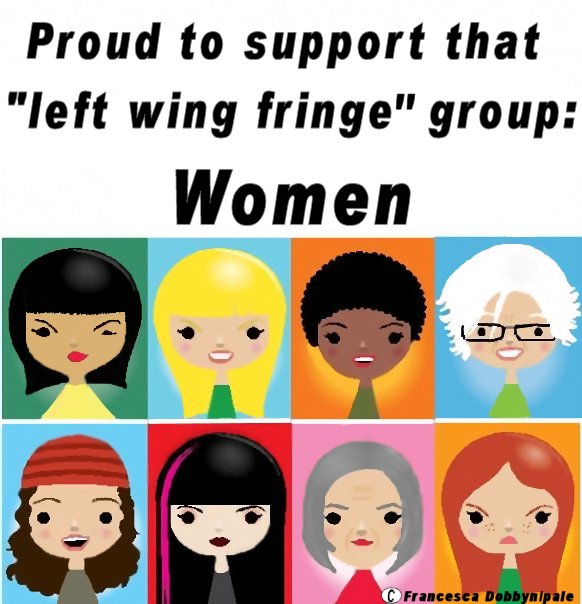
Apparently — and this, according to video footage of our Prime Minister — if you are a woman you are a member of one of those “left-wing fringe groups.”  Who knew? Watch the abbreviated version of Harper’s statement below (or catch the full meal deal here).

Antonia Zerbisias, a columnist at the Toronto Star, immediately took issue with our PM’s statements:

I’m thinking of making T-shirts: “Proud to be a member of that `left-wing fringe group’ called `Women.'”

Well, with support of a Facebook group that’s grown to almost 3,000 members, she’s followed through!  T-shirts are now available!

Version 1:

fringers

Version 2:

fringe supporters

And, as an added benefit to the cause of women’s rights, proceeds from t-shirt sales will go to the Women’s Legal Education and Action Fund (LEAF), an organization which lost a significant chunk of funding thanks to the Harper regime.

I’m looking forward to seeing those t-shirts on the bodies of folks here in the Queen City!  Go get ’em!

TRM @ Vertigo

Well, in case you somehow escaped my email and Facebook messaging, here’s notice that I’ll be giving a public reading at the autumn opener of the Vertigo Reading Series. Come out on Monday, September 28 to hear a Saskatchewan quartet of writers — Sheri Benning, Randy Lundy, David Sealy and me — share our words. The show gets underway sometime around 7 p.m. at  Aegean Coast Coffee and Tea, 1901 Hamilton Street (corner of 12th Ave & Hamilton St), in Regina.

See you there!

And because I’m feeling generous, a still-drafty poem to honour the work of the Prairie Lily Feminist Society!

There’s a war on women

and the United Nations knows it, created the Convention

on the Elimination of all forms of Discrimination

Against Women. CEDAW.

See, duh? It’s true.

There’s discrimination. Otherwise, why

are women 52% of the world’s population

and own only 1% of its land.

There’s a global war on women

but no one’s talking about it, not really.

CEDAW’s not working so well, the UN’s shifted

to Millenium Development Goals (MDGs) to fight an msg headache

the size of which no one wants to believe.

Women world-wide live in poverty, violence, disease

targetted by goals to make change. Goals.

There’s a war on women and it’s happening in Canada, too.

Mulroney and the boyz axed NAC, dissed

women’s work for equality. Chretien kept it up.

Chopped away at women’s programs, goodbye Cretin

and hello Paul Martin, Minister of Finance turned PM,

carried the axe for far too long.

There’s a war on women

and now Harper’s leading the charge.

No need for equality. Mandates

for feminism. Organizations which won significant rights —

Charter rights

reproductive choice

employment equity

same sex marriage —

goodbye.  A left-wing fringe group? Huh?

There’s a war on women

and it’s happening here, in Saskatchewan, too.

Ah, but the NDP, they’re different!

Not! Romanow and Link, lovers of feminists

until elected, tossed us aside in favour of debt reduction, big biz,

derided us as too radical. Quietly called us feminazis. Calvert

closed Women’s Sec, purged policy wonks

too Keynesian, captured headline praises from Fraser’s Institute,

that rightwing think tank the Harperites love.

There’s a war on women

and it’s here and now

Premier Wall won’t appoint a woman

to be Responsible for our status,

won’t balance gender on Enterprise SK,

and assigns 12 men to decide our uranium future.

He’d rather men continue their war

leaving us in poverty, earning 70 cents on a dollar

while his boyz call us dumb bitches .

There’s a war on women

and it’s right here and now

It’s right in your face, if you dare open

your eyes.

There’s a war on women

and we’re standing up to it.

Brave lilies, a feminist society, organizing.

—B. L. Wagner